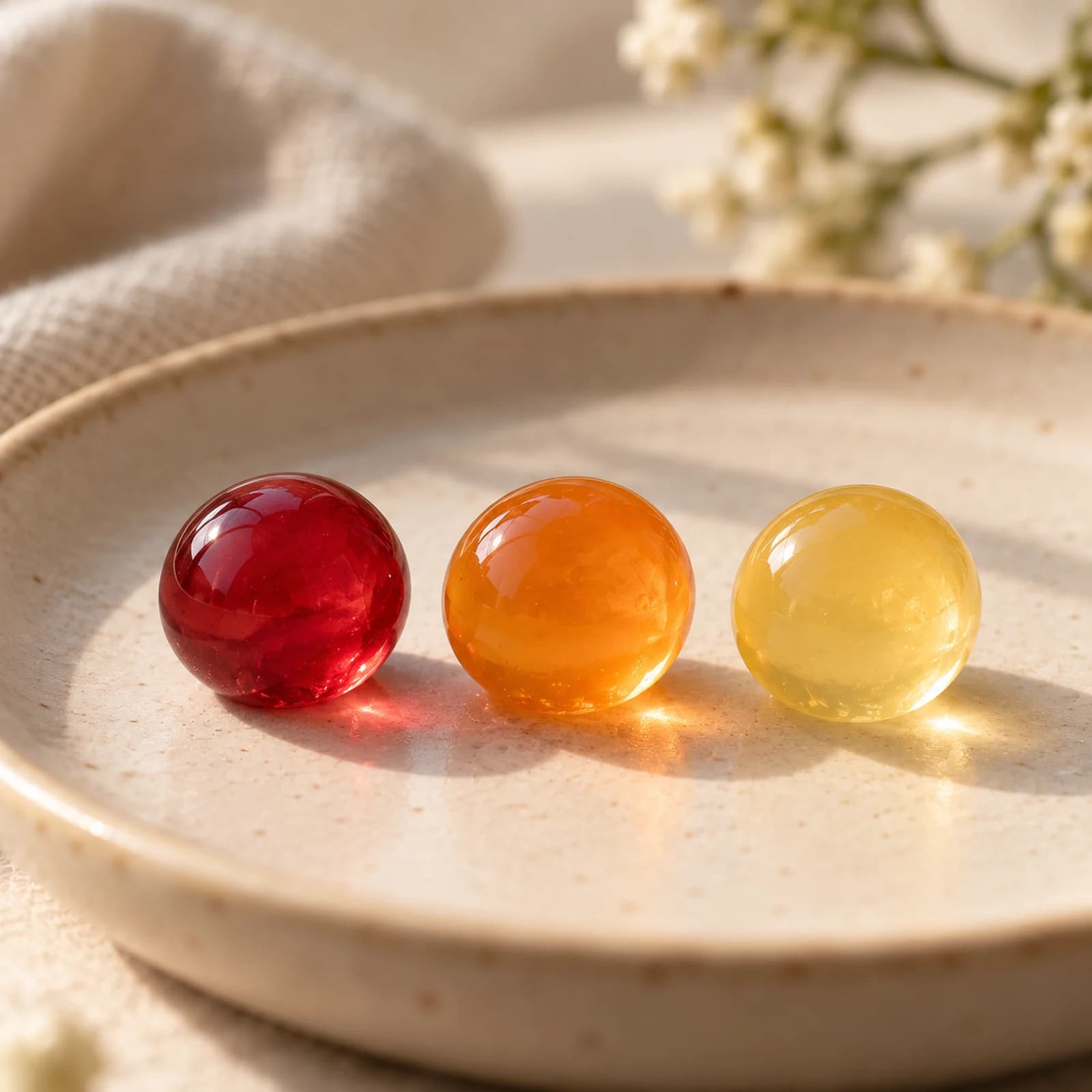
Popping pearls (also called popping boba) sit on top of bubble tea, frozen yogurt and café desserts, and most people meet them there before they know what to call them. This guide covers what they are made of, how the skin forms without any cooking, how they differ from chewy tapioca pearls and sabudana, and how to eat them.
They began in Taiwan, as a topping for bubble tea, and travelled from there into smoothies, slushies, frozen yogurt and desserts (Wikipedia’s article on popping pearls). In India you mostly find them at bubble-tea and frozen-yogurt counters, scooped from a tub. You can also keep them at home and use them in the drinks you already make: nimbu pani, iced tea, lassi, a glass of soda.
We are six people in Gurgaon who make Hibiscus, Peach and Lemon popping pearls. Where this page talks about our own pearls, it says so and goes by our ingredient list. Where it talks about popping pearls in general, it links the public source it took the fact from.
What’s inside a popping pearl
Every popping pearl has two parts. The outside is a skin: thin, soft and glossy. It holds its shape in a glass of soda or a bowl of yogurt and gives way the moment you bite. The inside is flavoured juice, and that juice is the burst. There is no seed, no chewy core and nothing to dissolve.
Because the flavour is in the juice, a popping pearl tastes of something on its own, not just of the drink it sits in. Tip a cup of Lemon pearls into plain soda and each burst is lemon; tip Hibiscus into lemonade and each burst is floral and tart.
In general, popping pearls are made from water, sugar, juice or other flavourings, and the two ingredients that make the skin (Wikipedia’s article on popping pearls). Here is our Hibiscus list in plain words, from the manufacturer’s provisional trial-batch declaration of 6 October 2026:
- Water, sugar and liquid glucose: the body of the juice.
- Hibiscus flower extract: where the ruby colour comes from.
- Electrolyte salts (sodium chloride, potassium chloride, sodium citrate, dextrose): the reason ours are popping pearls with electrolytes.
- Sodium alginate and calcium lactate: the pair that makes the skin, listed as the gelling agent and the firming agent.
- Guar gum and xanthan gum: thickeners.
- Citric acid: an acidity regulator.
- Potassium sorbate: a preservative.
- Hibiscus and vanilla flavouring substances.
There is no tapioca starch and no gelatin in that list. The percentages are still pending, so it is provisional, and the label on your pack is the final word. The declaration is printed word for word on our What’s inside page. Peach and Lemon have their own lists, printed on their packs.
How the skin forms (no cooking)
The skin comes from a kitchen technique called spherification. A liquid that contains sodium alginate meets a bath that contains calcium. Where the two touch, the outside of each drop sets into a thin, flexible skin, and the inside stays liquid. The classic method drips the alginate liquid into a cold calcium solution; there is no boiling and no oven in it (Wikipedia: Spherification).
Sodium alginate is refined from brown seaweed and is used in food as a gelling agent (Wikipedia: Sodium alginate). Popping pearls pair it with calcium chloride or calcium lactate (Wikipedia’s article on popping pearls). Our Hibiscus list names sodium alginate (INS 401) as the gelling agent and calcium lactate (INS 327) as the firming agent: the same pair.
There are two ways to run the reaction. In basic spherification the alginate is in the juice and the calcium is in the bath. In reverse spherification it is the other way round: the calcium is in the liquid and the drop is lowered into an alginate bath, which suits liquids that already contain calcium, such as milk (Wikipedia: Spherification). Either way, the skin is what holds the juice together, and it is why a popping pearl bursts instead of chewing.
The reaction is old: Unilever documented it in the 1950s, and restaurant kitchens later used it to turn juices into little spheres that look like caviar (Wikipedia: Spherification). For you, it means the pearls arrive ready. There is no pot and no timer: you peel the lid and they go in, cold, at the end.
Popping pearls vs tapioca pearls (and sabudana)
They can look alike in a glass. They are nothing alike to eat.
- Tapioca pearls are made of tapioca, a starch extracted from the cassava root. They are soaked and boiled before use, and they end up soft, chewy and elastic (Wikipedia: Tapioca). In bubble tea they are usually dark, because they are cooked with brown sugar (Wikipedia: Bubble tea).
- Sabudana, the pearls in sabudana khichdi, are tapioca pearls too: it is the name they go by across the Indian subcontinent (Wikipedia: Tapioca).
- Popping pearls are juice in a skin. Nothing to boil, nothing to chew, and a burst when you bite.
The full comparison, with a table and which drink suits which, is in popping pearls vs tapioca pearls.
How to eat popping pearls
Three rules cover almost everything.
- Cold or room temperature. Pearls are a finish, not an ingredient. They are never boiled, baked or blended, and they stay out of hot chai and hot coffee.
- Last. Ice first, then the pour, then the pearls. Added last, they go in whole and stay whole.
- Or straight from the cup. Peel the lid, take a spoon, pop.
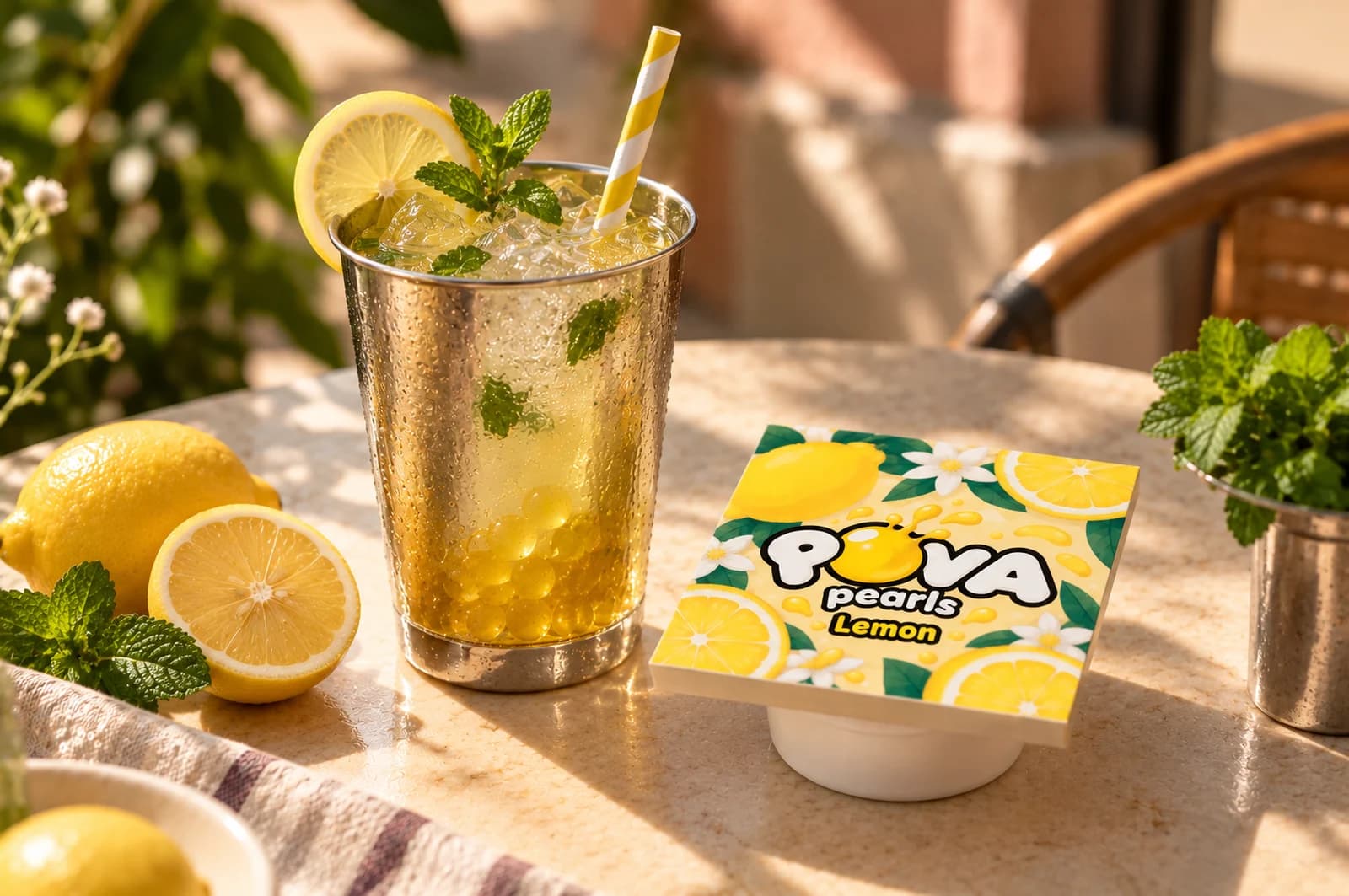
Timing matters at the cold end too. Left overnight in oats, or spooned onto custard that is still warm, the pearls soften. So the overnight oats get their pearls in the morning, and the fruit custard waits until it is fridge-cold. There is more on this, with a flavour-by-flavour table, in how to use popping pearls.
What they go with
Anything cold that could use a little burst. There are 46 recipes on this site, and every one counts the pearls by the cup.
- Drinks: soda, nimbu pani, iced tea, lassi, coconut water and lemonade, with the pearls tipped in last. Start with the drink recipes, or the peach iced tea.
- Desserts: spooned over yogurt, ice cream, kulfi, cut fruit or a cold slice of cheesecake. See the dessert recipes, or the kulfi sundae.
- Breakfast: on overnight oats in the morning, or across a smoothie bowl after the blender. See the breakfast recipes.
- Parties: a lassi bar where everyone picks a flavour, a tray of shot glasses in three colours, a punch. See the party recipes, or the lassi bar.
Why a single cup
In India, popping pearls usually come scooped from a big tub behind a café or frozen-yogurt counter. That works for a shop. At home, a tub means guessing how much to use and an open container at the back of the fridge.
So we made one sealed serving to tip into whatever is already in your glass. Each Pova Pearls cup holds 40 ml, which is one serving: peel the lid, tip it in, done. There is nothing to measure, and the recipes on this site are written in cups for the same reason.
A single cup is ₹100. Packs of 3, 6 and 9 cups are ₹279, ₹539 and ₹799, in one flavour or mixed. The shop page has all of them side by side.
The same cup works behind a counter. A café or an event bar opens one cup per drink, so there is no tub left open behind the bar and every glass gets the same amount. Cafés, caterers and event bars can ask for a sample kit and a written rate card on our page for cafés and events.
Three flavours
- Hibiscus popping pearls: floral up front, tart on the finish. The colour comes from hibiscus flower extract. Good in soda, lemonade and rose milk.
- Peach popping pearls: soft and juicy. Good in iced tea, over vanilla ice cream and on overnight oats in the morning.
- Lemon popping pearls: bright and zesty. Good in nimbu pani, iced green tea and on cheesecake.
Strawberry and Lychee are coming soon. Every flavour’s recipes are one tap away on the Hibiscus, Peach and Lemon recipe lists, and the words used on this page are defined in the popping pearl glossary.